

Will the right checklist, planner, or household management app fix your home life?
(Spoiler: Not on its own. It was never just about the to-do list)

We’ve all chased the perfect system. Walked the HomeGoods office supply aisle, hoping that color-coded calendars or gel pens would make managing housework feel less like a bummer. Crossed our fingers that shared task apps or Sunday resets would finally bring peace and balance to our homes.
Unfortunately, domestic equity isn’t something you can download. It’s not just about what gets done—it’s about how, why, and who’s carrying the weight behind the scenes. The dishes aren’t just about the dishes. The work—mental, emotional, physical—that keeps our lives running is deeply embedded in how we live, connect, and relate to each other. It goes a lot deeper than who’s sorting socks.
Welcome to Time to Lean, a podcast and platform where we explore what it means to truly share the load—at home, in relationships, and in life. In this post, we're laying the groundwork for some of our biggest themes: mental load, emotional labor, and what real domestic equity actually looks like.
And don’t miss your free printable Home Cleaning Checklist (yes, ironic to offer you a checklist in a post that explicitly says a checklist won’t fix things)—a simple, shareable tool to help build more visible, equitable rhythms at home. Skip to the bottom of the post to download!
What is the Mental Load?
You know that feeling of always keeping everything in your head? Doctor’s appointments, whose socks need replacing, the gift you haven’t bought yet, and that birthday party RSVP you still haven’t sent?
That’s the mental load! It’s the invisible project management of home and family life. We like to call it “domestic engineering”—because keeping a household running smoothly requires strategy, foresight, and constant calibration.
It’s not just about doing things. It’s about anticipating, planning, and remembering—from restocking toilet paper to scheduling dentist appointments, to knowing when your kid’s shoes will be too small next season. And even in households where chores seem “split,” this cognitive labor often falls disproportionately on one partner(usually women).
What is Emotional Labor?
Emotional labor is the often-unseen work of managing feelings—both your own and others’. It’s the effort of smoothing social dynamics, soothing kids, remembering preferences, noticing when someone’s upset, and adjusting to maintain harmony.
At home, this can look like:
Being the default for calming tantrums
Keeping track of in-laws' birthdays
Knowing when someone needs space (or a snack)
Softening your own tone to avoid conflict
Making sure everyone feels included and “okay”
But it goes deeper than that! It’s about maintaining the emotional environment of the household, short- and long-term. It’s thinking about overall family well-being, considering each person’s preferences, values, and priorities, and making careful decisions for the good of the group—even when you’re frustrated, tired, or would rather not.
This labor is crucial, but rarely recognized, named, or distributed equitably.
Big shout out to Rose Hackman for her book Emotional Labor and all the work she’s done to bring visibility and depth to this topic.
What Does Domestic Equity Really Mean?
Domestic equity isn’t just about who does the dishes.
It’s about shared ownership of the home, the family’s well-being, and the systems that keep life running. That includes:
Aligning on your values: What matters to us? How clean is “clean enough”?
Creating collaborative systems: Who’s doing what, and when?
Practicing continuous communication: How are we feeling about this setup? What needs to shift?
Think of it like co-leading a team. It’s not about “helping”—it’s about owning your role in the shared space.
True domestic equity requires us to consider our unique needs and actual capacities, not just split tasks 50/50. It means unpacking the outside expectations we've absorbed—many of them rooted in oppressive norms that leave us burnt out, stretched thin, or stuck in roles we didn’t choose.
Equity isn’t simply about equality. It’s complex, messy, adaptive, flexible, HUMAN. Equity plays to our strengths, encourages accommodations, and is built on a foundation of creativity, communication, and collaboration.
Quick Key Terms
Use these to start conversations or to reframe common dynamics:
Mental Load = cognitive weight of managing everything
Emotional Labor = tending to feelings + emotional dynamics
Domestic Engineering = the thoughtful management of the mental, emotional and physical demands of family life
Domestic Equity = a balance of the distribution of all kinds of household work that reflects the needs and capacities of the individuals and the collective
Invisible Work = tasks that go unseen but are crucial (e.g., remembering, organizing, prepping)
Collaborative + Curious Home Culture = moving from task-based to creative, values-based co-ownership
What You’ll Get From Time to Lean
Weekly podcast episodes, essays, and resources covering:
Real conversations about mental load & labor
Tools and language to make change at home
Insights from guests who are shifting the culture
Tangible practices for rebalancing the domestic sphere
We’re not just handing you checklists and household management tools. Those are important pieces of the puzzle, but Time to Lean is about more than that. We’re inviting you into a conversation. One where care is shared, values are aligned, and the daily work of home and family becomes a collective, intentional practice. Our goal isn’t perfection. It’s connection, clarity, and a culture of equity that actually reflects what it means to be human.
Now about that checklist…
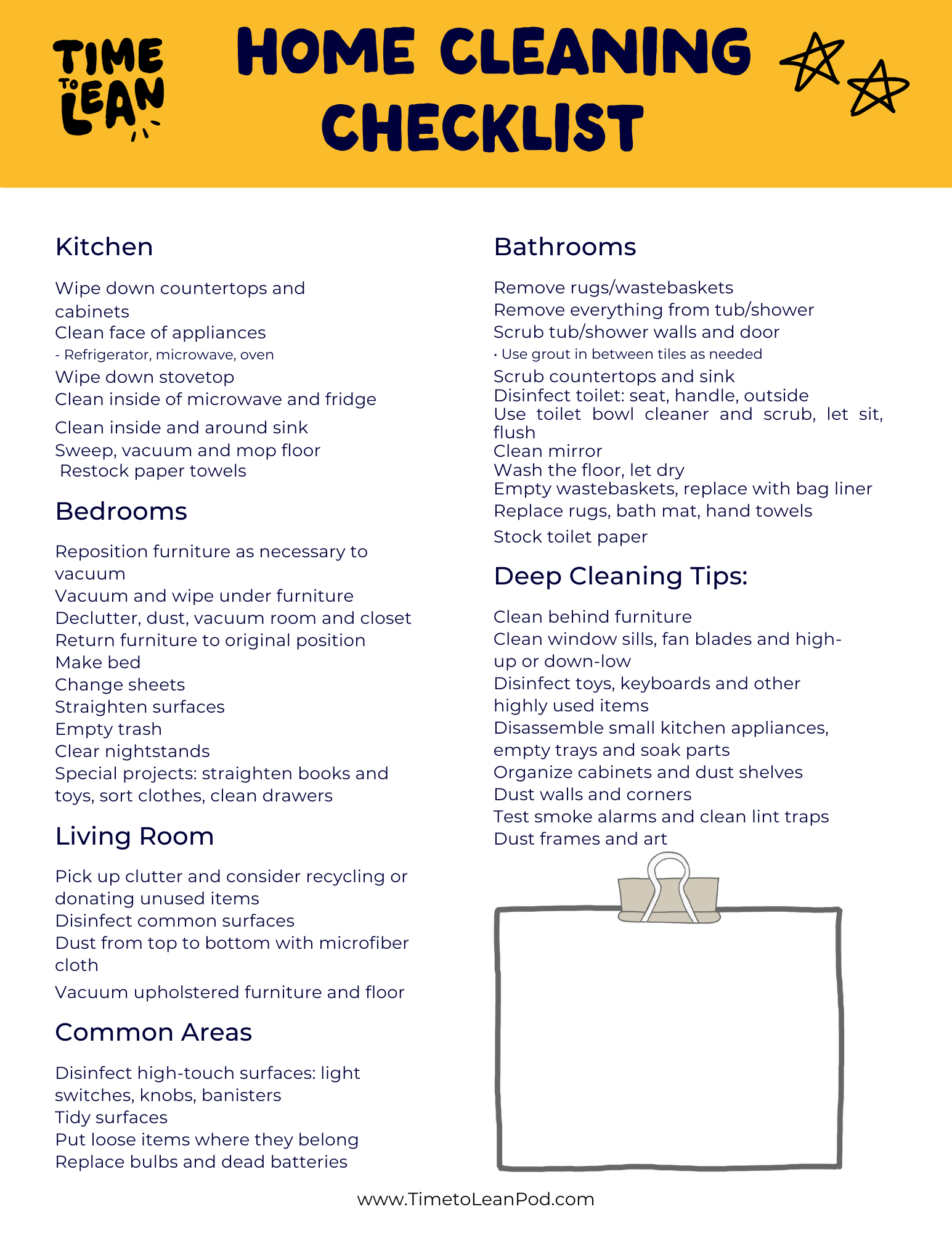

FREE RESOURCE: Printable Home Cleaning Checklist
This printable one-sheet home cleaning checklist is meant to help with chores, but it’s also meant to spark dialogue. Use it as a jumping-off point for visibility, shared planning and conversations about what "clean" means to you!
Love time to lean!! Excited to find you on here :)